

What are lingual orthodontic braces?
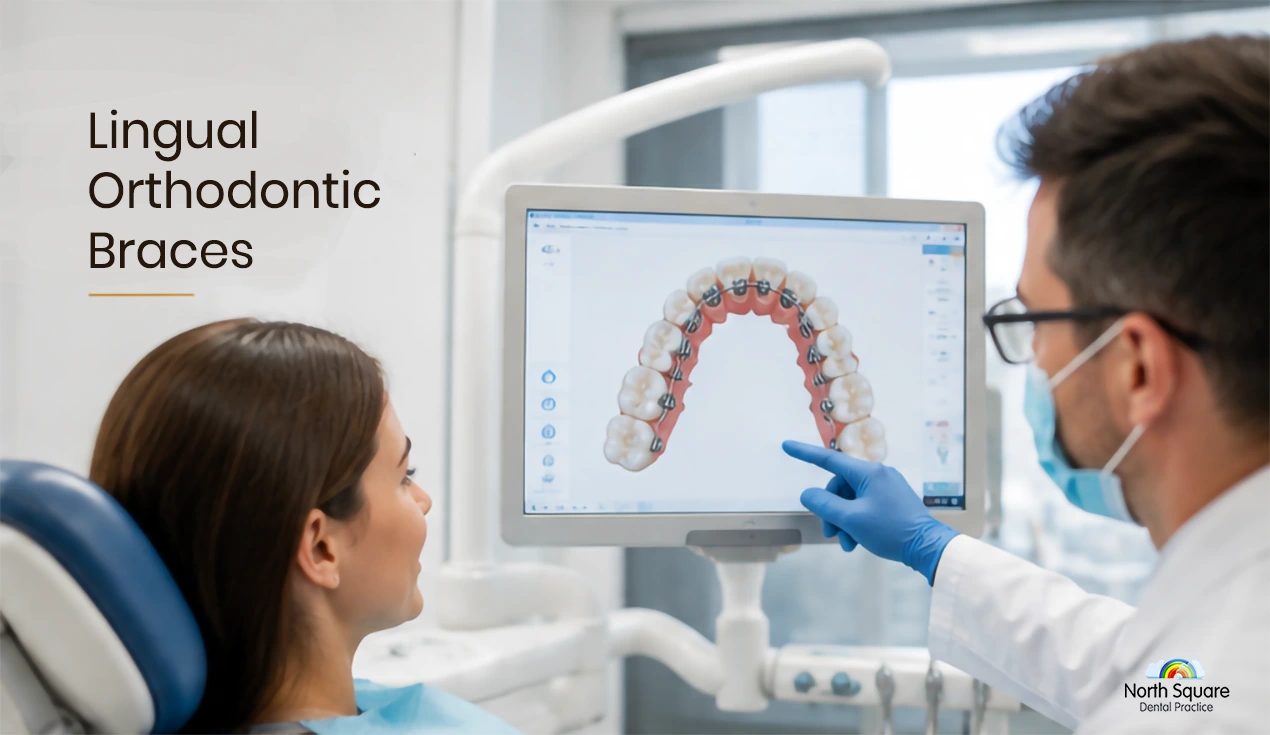
Lingual orthodontic braces are fixed braces attached to the inside surfaces of your teeth, rather than the front. Because the brackets and wires sit against the tongue side of the teeth, they are almost impossible to see when you smile.
They work on the same basic orthodontic principle as conventional fixed braces: controlled forces are applied to individual teeth so they gradually move into planned positions. The important difference is where the appliance sits.
That small change creates a surprisingly different treatment experience.
Lingual braces can offer very precise three-dimensional tooth movement and, unlike removable aligners, they remain attached to the teeth throughout treatment. The British Orthodontic Society notes that lingual appliances can treat a broad range of orthodontic problems, while also pointing out that the technique requires additional skill and experience.
The trade-off is straightforward: you gain almost complete invisibility, but you have to adapt to having brackets in a space your tongue normally uses.
For some patients, that is an excellent trade. For others, clear aligners or discreet braces on the front of the teeth make more sense.
How do lingual braces work?
The brackets are bonded to the back of the teeth, usually on the upper and/or lower arches. An orthodontic wire then connects the brackets and applies carefully controlled forces.
Modern lingual systems can be customised to the individual patient’s teeth. That matters because the back surface of every tooth is different. It is not a flat, uniform platform.
In a customised system, digital scans or impressions can be used to design brackets and positioning around the patient’s individual anatomy. The orthodontist then plans how each tooth should move and how the appliance should deliver those forces.
This is one reason lingual orthodontics should not be judged simply as “normal braces turned around”.
Why the position of the brackets matters
The back of the teeth is much closer to the tongue than the front is to the lips and cheeks.
That changes several things at once:
- Your tongue may repeatedly touch the brackets while speaking.
- The appliance can feel bulky during the first few days.
- Cleaning requires a different technique.
- Bracket design and thickness become particularly important.
- Small differences in tooth anatomy can affect comfort.
- The orthodontist has less physical working space than with conventional braces.
Modern, thinner bracket designs have improved comfort and speech for some patients, but they have not eliminated the adjustment period. Research specifically examining lingual treatment has found that bracket thickness can influence both comfort and speech.
Who are lingual braces suitable for?
Lingual braces are particularly attractive to adults who want fixed orthodontic treatment without having visible brackets on their teeth.
They can be considered for problems such as:
- Crowded teeth
- Crooked teeth
- Gaps between teeth
- Rotated teeth
- Certain bite problems
- More complex tooth movements where fixed appliances offer useful control
The important point is that suitability is not determined by appearance alone.
A patient may love the idea of hidden braces but have a bite, tooth shape, gum condition or treatment objective that makes another appliance more sensible.
A proper orthodontic assessment should therefore come before choosing the appliance.
The British Orthodontic Society specifically advises patients to ask about the clinician’s training and experience with the particular brace system being recommended. That is especially relevant for lingual treatment because relatively few orthodontists routinely provide it.
The part people underestimate: your tongue
This is probably the biggest difference between lingual braces and conventional braces.
Your tongue is constantly moving. You use it to speak, swallow and position food. When brackets are placed behind your teeth, the tongue suddenly has a new surface to interact with.
During the first few days, it is common for the tongue to repeatedly rub against the brackets.
That can feel much more noticeable than the actual movement of the teeth.
Some patients describe it as a rough or crowded feeling. Others mainly notice soreness at particular points where the tongue repeatedly contacts a bracket.
Your orthodontist may use orthodontic wax or other measures to make the adjustment period easier. More importantly, the appliance itself matters. A thinner, well-designed system can make a noticeable difference.
This is why two people can have very different experiences with “lingual braces” even though they technically have the same type of treatment.
Do lingual braces affect your speech?
Yes, they can.
This is one of the few disadvantages that deserves more attention than it usually gets.
Because the tongue helps produce many speech sounds, placing brackets directly behind the teeth can temporarily change how certain sounds are formed. The “s”, “t”, “d”, “r” and similar sounds can be affected.
A systematic review of research into orthodontic appliances found that speech changes can occur with several appliances, with lingual fixed appliances having a particularly noticeable effect. Most speech changes improve as patients adapt, although distortion of the “s” sound can persist for longer in some cases.
This does not mean you will permanently speak differently.
Most people adapt.
But if you are a teacher, presenter, broadcaster, actor, salesperson or someone who spends hours speaking professionally every day, this deserves discussion before treatment.
A useful practical test is to ask your orthodontist whether you can see and, if appropriate, try the proposed appliance before committing to treatment.
Can you speed up speech adaptation?
There is no magic exercise that guarantees instant adaptation.
The most useful thing is simply speaking regularly.
Read aloud. Have conversations. Practise difficult words. If your speech feels slightly strange, avoiding conversation because of embarrassment can actually make the adjustment feel more frustrating.
Your tongue needs to learn the new boundaries inside your mouth.
That is adaptation, not damage.
Lingual braces vs traditional braces
Both are fixed appliances, so neither can be removed by the patient during normal treatment.
The major difference is visibility.
| Feature | Lingual braces | Traditional fixed braces |
|---|---|---|
| Position | Behind the teeth | Front of the teeth |
| Visibility | Very difficult to see | Visible |
| Tongue contact | High | Low |
| Initial speech impact | More likely | Usually less noticeable |
| Lip/cheek irritation | Usually less | More common |
| Cleaning | Can be more difficult | Generally easier to see |
| Customisation | Often highly customised | Varies by system |
| Cost | Usually higher | Usually lower |
| Specialist experience | Particularly important | More widely available |
There is also an interesting difference in where irritation occurs.
With conventional braces, the lips and cheeks are often the parts that complain.
With lingual braces, it is usually the tongue.
Research comparing the two techniques has consistently found more tongue pain and speech difficulty with lingual appliances, while cheek and lip discomfort can actually be lower.
So “more comfortable” is not really the right question.
It is more accurate to ask: where will the discomfort come from?
Lingual braces vs Invisalign
The comparison with Invisalign-style clear aligners is more complicated because these are fundamentally different treatment systems.
Lingual braces are fixed.
Clear aligners are removable.
That difference affects everyday life more than the word “invisible” suggests.
| Lingual braces | Clear aligners | |
|---|---|---|
| Visibility | Almost invisible | Almost invisible |
| Removable | No | Yes |
| Eating | Appliance remains in place | Remove aligners |
| Cleaning | Clean around fixed brackets | Brush teeth after removing aligners |
| Speech adjustment | Can be noticeable | Usually less affected, though not always |
| Compliance | Less dependent on patient remembering them | Strongly dependent on wearing them as instructed |
| Complex movements | Can provide strong fixed-appliance control | Depends heavily on case and planning |
| Appointments | Adjustment visits required | Reviews plus new aligner stages |
| Tongue irritation | Possible | Usually much less |
| Appliance breakage | Possible | Trays can be lost or damaged |
The key advantage of an aligner is also its biggest weakness.
You can take it out.
That is convenient when eating, brushing or attending an important event. But the treatment only works as planned if the aligners are worn sufficiently and changed as instructed.
Lingual braces remove that compliance issue because the appliance stays on the teeth.
On the other hand, you cannot simply take lingual braces out for dinner, a presentation or a special occasion.
A recent systematic review of adult orthodontic treatment found differences in quality-of-life and side-effect experiences between removable aligners and fixed appliances, while also highlighting that the evidence comparing lingual appliances with other modern options remains limited.
So don’t choose between them because one is marketed as “invisible”.
Choose based on what needs moving, how reliably you can follow the treatment, and what you are willing to tolerate every day.
Are lingual braces more expensive?
Usually, yes.
There is a good reason.
Lingual orthodontics requires specialised planning, specialised equipment and greater clinical skill. Many systems are individually customised, and fitting and adjusting brackets on the back of the teeth takes more time therefore lingual appliance fees are generally much higher than conventional fixed braces because of material costs, additional surgery time and the extra training involved.
So if you see a quote that is significantly higher than a conventional brace, it does not automatically mean you are being charged simply for the word “invisible”.
There is more clinical work involved.
Lingual braces cost in the UK
There is no single national price for lingual braces.
The cost depends on:
- Whether one or both arches are treated
- How complicated the tooth movements are
- Whether the brackets are customised
- The orthodontist’s experience
- Laboratory and digital planning costs
- How long treatment is expected to take
- Whether additional procedures are required
- What retainers and follow-up care are included
For context, private orthodontic treatment can range from around £2,000 to £6,000, depending on complexity and appliance type, with fees sometimes higher. That is a general orthodontic range rather than a specific lingual-brace price.
Lingual treatment will commonly sit towards the higher end of private orthodontic pricing because of its specialised nature.
Rather than asking only “How much are lingual braces?”, ask for the total treatment cost.
That should clarify whether the quote includes scans, fitting, routine adjustments, emergency visits, removal, retainers and post-treatment reviews.
A cheaper initial quote can become much less attractive if important parts of treatment are charged separately.
What actually determines the price?
One detail patients often miss is that the appliance itself is only part of the cost.
Imagine two patients both asking for lingual braces.
Patient A has mild crowding and needs limited movement.
Patient B has significant crowding, a complicated bite and requires additional space management.
They are not buying the same treatment simply because both have “lingual braces”.
The planning, number of appointments, complexity of movement and finishing requirements can be very different.
This is why a consultation and treatment plan are much more useful than a generic price advertised online.
Lingual braces before and after: what should you expect?
The “before” photograph normally shows the teeth in their original position, while the “after” photograph shows the final alignment.
But a good orthodontic result is about more than making the front teeth look straight.
Your orthodontist is also considering:
- How the upper and lower teeth meet
- The position of individual tooth roots
- The amount of crowding
- The relationship between the front and back teeth
- Midlines
- Tooth angulation
- The stability of the final result
- How the teeth function when you bite
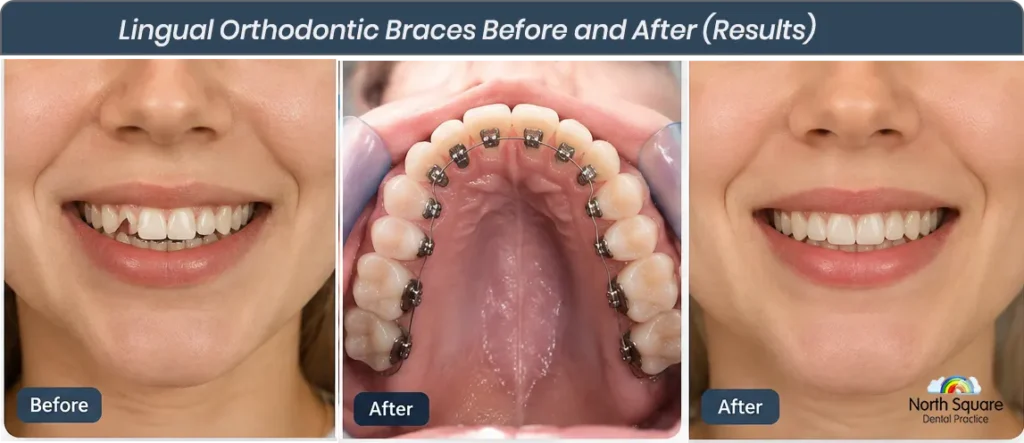
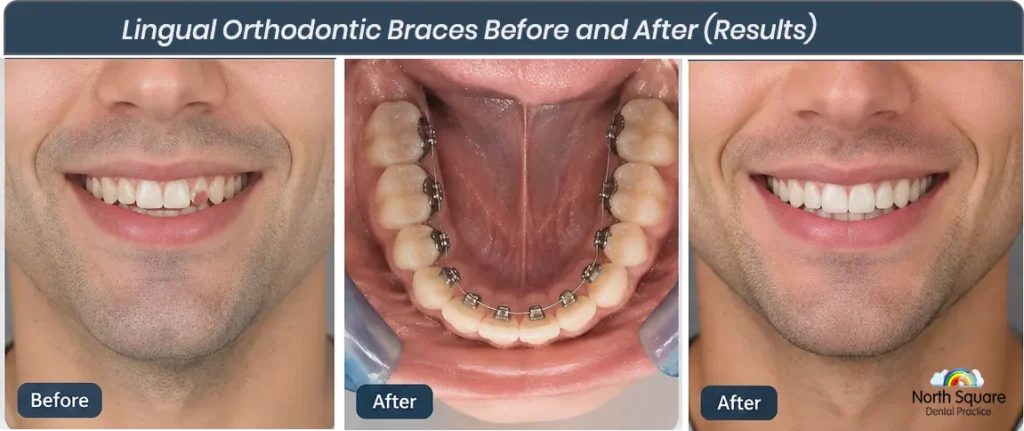
This is why two before-and-after photographs can look equally impressive while representing very different levels of orthodontic complexity.
Why your “after” result may not look exactly like the digital preview
Digital treatment simulations are useful planning tools.
They are not guarantees.
Tooth movement happens biologically, and individual teeth do not always respond exactly according to a computer-generated prediction. Refinements may sometimes be required.
This is particularly important when choosing an orthodontist. A good clinician should be willing to explain not only the expected final appearance but also what happens if certain teeth do not track or move exactly as planned.
The goal is not to create a beautiful computer animation.
It is to produce a healthy, functional and stable result in your mouth.
How long do lingual braces take?
Treatment length depends much more on the orthodontic problem than on the fact that the braces are lingual.
Some relatively straightforward cases can be completed in a shorter period, while more complex bite and tooth-position problems take considerably longer.
For orthodontic treatment generally has a broad range of approximately 6 to 30 months, depending on complexity.
It is better to be suspicious of a fixed promise such as “six months for everyone” than impressed by it.
Moving teeth is biological.
The orthodontist can plan the forces, but cannot simply order the teeth to move at a predetermined speed.
What does eating feel like with lingual braces?
The first few days can be awkward.
Your tongue is adapting to the brackets, and your teeth may be tender after fitting or adjustments.
Soft foods can make the first few days easier.
After that, most patients return to a fairly normal diet, although hard or sticky foods can damage fixed appliances.
The interesting point is that eating difficulty with lingual braces is not simply about pain. It can also be about learning where food goes and how your tongue interacts with the appliance.
Research has found greater eating difficulty with lingual appliances in some comparisons, although the evidence base is not strong enough to say that every patient will experience this.
Cleaning lingual braces is harder than it looks
This is one area where patients can get caught out.
With braces on the front of your teeth, you can see the brackets while brushing.
With lingual braces, you are cleaning a surface that you cannot easily see.
You are effectively brushing by feel.
A good routine usually includes:
- Fluoride toothpaste
- Careful brushing around each bracket
- Interdental cleaning
- Small interdental brushes where appropriate
- Regular dental examinations
- Professional hygiene care when recommended
Maintaining good oral hygiene is particularly important during orthodontic treatment because plaque around appliances can contribute to tooth decay and gum problems.
There is an interesting twist with lingual braces, though.
Because the brackets are on the tongue side, research suggests that the risk of visible white-spot lesions can be lower on those surfaces than around conventional brackets on the front. That does not mean lingual braces make poor brushing harmless. Plaque can still accumulate around the appliance, and gum health still depends heavily on what you do at home.
What happens if a lingual bracket comes loose?
A loose bracket is worth reporting rather than simply waiting for your next appointment.
Because lingual brackets are positioned in a confined space, a loose component can irritate the tongue or interfere with the wire.
Your orthodontic practice can tell you whether it needs an earlier repair.
Do not try to bend the wire or reposition a bracket yourself.
And if the appliance is repeatedly breaking, tell the orthodontist. Repeated breakages may point to biting forces, appliance design, placement or another issue that needs addressing.
Are lingual braces painful?
There can be discomfort, especially after fitting and adjustments.
But “painful” can be misleading because there are different types of discomfort.
Your teeth may feel tender because orthodontic forces are being applied.
Your tongue may feel sore because it is rubbing against the brackets.
These are separate sensations.
Evidence comparing lingual and conventional fixed appliances suggests that overall pain may be broadly similar, but lingual treatment shifts more of the discomfort towards the tongue.
For many patients, the tongue irritation is the more memorable part of the first week.
It usually becomes much less noticeable as the mouth adapts.
Are lingual braces worth it?
For the right patient, they can be.
If your main priority is having fixed braces that other people are unlikely to notice, lingual orthodontics has a genuine advantage. It is not simply clever marketing.
But you are paying for that discretion with higher cost, a more demanding cleaning routine and a greater likelihood of early tongue and speech issues.
I would think about the decision this way:
Choose lingual braces if invisibility is important enough to you that you are willing to accept the additional cost and adaptation period.
If invisibility matters but you strongly dislike the idea of brackets touching your tongue, clear aligners may be a better starting point.
For patients mainly concerned about cost, conventional fixed braces are usually the more straightforward option.
With a complex orthodontic problem, the treatment requirements should come first. Choose the appliance that can achieve the right result, rather than deciding on the appliance before the assessment.
You also shouldn’t have to convince your orthodontist that you want lingual braces. They should be able to explain why this approach makes sense for your particular teeth, and how it compares with the alternatives.
Frequently asked questions
No brace is literally invisible, but lingual braces are positioned behind the teeth and are extremely difficult to see during normal conversation or smiling.
The braces themselves are not intended to damage healthy teeth, but poor cleaning during orthodontic treatment can increase the risk of decay and gum problems. Good oral hygiene is essential.
They can temporarily affect speech, particularly sounds involving the tongue and the front of the mouth. Most patients adapt, although some people experience speech changes for longer than others.
After the initial adjustment period, most people can eat a relatively normal diet, but hard and sticky foods can damage fixed appliances and should generally be avoided.
Yes. Teeth can move back after orthodontic treatment, so retainers are normally required to maintain the result.
Treatment length varies according to the orthodontic problem. A straightforward case may take considerably less time than a complex bite correction, so an individual treatment plan is more useful than a generic timeframe.
Why choose North Square Dental Practice for orthodontic care?
Choosing an orthodontic treatment is not really about finding the brace with the most impressive name. It is about having someone assess your teeth properly, explain the available options and tell you when the treatment you initially had in mind may not be the best choice.
At North Square Dental Practice, the useful starting point is a proper assessment of your teeth, bite, oral health and treatment goals. If lingual braces are appropriate, you can discuss what the treatment would involve, what the likely compromises are and how it compares with other discreet options.
Interested in finding out whether lingual braces are suitable for you? Contact North Square Dental Practice to arrange an orthodontic consultation and discuss your options.